
The Corsair T1 Race has been a staple in the gaming chair market since its launch, back when racing-style seats first started flooding home setups. Fast-forward to 2026, and the landscape’s changed. New brands have flooded the market, ergonomic priorities have shifted, and the once-premium T1 Race now competes in a crowded mid-tier space. But does it still hold up?
This review digs into whether the Corsair T1 Race deserves a spot at your battlestation or if it’s been surpassed by newer options. We’ll cover build quality, real-world comfort during marathon sessions, adjustability, and how it stacks up against alternatives that didn’t exist when this chair first dropped. If you’re wondering whether to pull the trigger or keep shopping, here’s what you need to know.
Key Takeaways
- The Corsair T1 Race delivers solid mid-tier value at $299–$349 with reliable build quality and firm cushioning, though newer competitors now offer better features at comparable prices.
- Leatherette upholstery and restrictive bolster design make this gaming chair less suitable for hot environments or larger builds, limiting its universal appeal.
- The chair excels for 2–3 hour gaming sessions with good posture support, but extended 4+ hour marathons reveal heat-trapping issues and limited postural adaptability.
- 3D adjustable armrests and a Class 4 gas lift provide solid basic ergonomics, but lack the 4D armrest adjustability and fabric options becoming standard on newer 2026 gaming chairs.
- Best suited for average-sized gamers (5’5″–6’2″) who prefer firm support over plush comfort and value the racing aesthetic, but not recommended for tall, heavier, or heat-sensitive users.
Design and Build Quality
Racing-Inspired Aesthetics
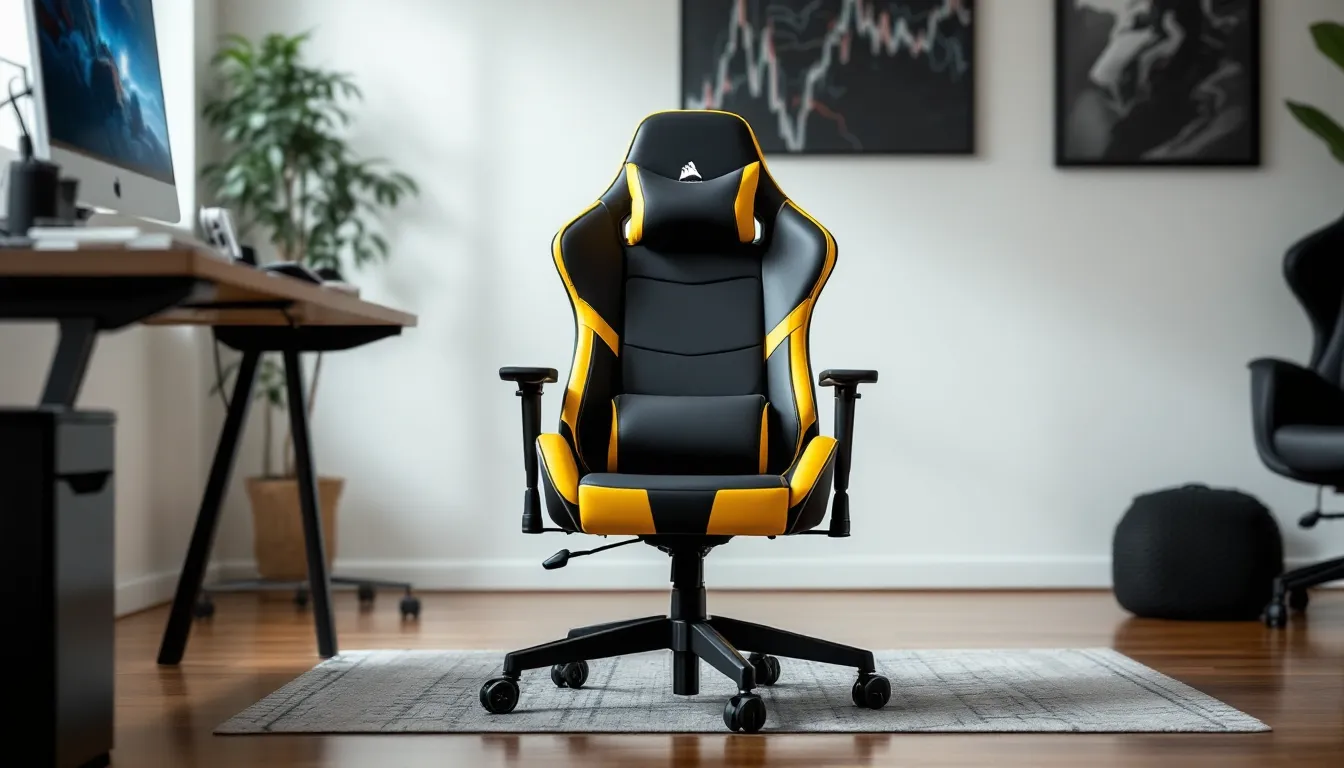
The T1 Race commits fully to the racing chair aesthetic, high backrest, bolstered wings on the seat and back, and contrast stitching that screams “bucket seat.” Corsair offers it in multiple colorways, including the classic black-and-yellow combo that matches their peripheral lineup.
The look is polarizing. If you’re into the racer vibe, it delivers. If you prefer minimalist or office-friendly designs, this isn’t it. The wingback design is pronounced enough that it won’t blend into a professional Zoom background, but for a dedicated gaming space, it fits right in.
Materials and Construction
The frame is steel, which is standard at this price point, and the base is aluminum. The covering is leatherette (PU leather), not fabric, which means it cleans easily but can get sticky during summer sessions if you don’t have AC.
The stitching quality is solid. After extended use, there’s minimal fraying or separation along seams, something cheaper racing chairs struggle with. The castors are 60mm nylon, smooth on hardwood but prone to scuffing if you’re rolling over rough surfaces repeatedly.
Weight capacity is rated at 264 lbs (120 kg), which is respectable but not class-leading. Heavier users should consider whether that threshold works for long-term durability.
Comfort and Ergonomics
Cushioning and Padding
The seat cushion uses cold-cure foam, which is denser than the cheap stuff but not memory foam. Out of the box, it feels firm, almost too firm if you’re used to plush office chairs. Over the first few weeks, it breaks in slightly, but it never becomes soft.
For some, that firmness is a feature. It prevents the “sinking” feeling that leads to posture collapse during long sessions. For others, especially lighter users or those with bony hips, it can feel unforgiving after 3-4 hours.
The backrest padding is similarly firm, with extra cushioning around the lumbar zone. The wings add side support, which is great if you lean into turns during racing sims but restrictive if you shift positions frequently.
Lumbar and Neck Support
Corsair includes removable lumbar and neck pillows, standard memory foam cushions with elastic straps. They’re adjustable vertically, which is good, but the straps can slip during recline adjustments.
The lumbar pillow is on the small side. If you have a pronounced lower back curve or prefer aggressive lumbar support, you might need to supplement it or swap it out. The neck pillow works well if you recline past 120°, but it gets in the way when sitting upright for competitive play.
Some users ditch both pillows entirely, relying on the chair’s built-in contours. That’s viable if you have good posture, but without them, the T1 Race feels more like a bucket seat than an ergonomic throne.
Adjustability Features
Armrests and Recline Functions
The armrests are 3D adjustable: height, angle, and horizontal slide. Not 4D (no lateral pivot), which is becoming more common in 2026 competitors. The adjustment range is decent, but the locking mechanism can loosen over time, leading to slight wobble after 6-12 months of heavy use.
The recline goes from 90° to 180°, which is overkill for most but fun if you want to lean back between rounds. The tilt tension knob offers some resistance customization, though it’s not as granular as premium models. The recline lock clicks at fixed intervals, no infinite adjustment.
Height and Tilt Adjustments
The Class 4 gas lift provides smooth height adjustment across a range suitable for desks 28-30 inches tall. It’s held up well in long-term tests, with no noticeable sag after a year of daily use.
The tilt mechanism is basic, rock or lock. No multi-tilt or synchronized tilt options, which some ergonomic purists prefer. For gaming, the simpler system is fine, but if you’re also using this for work that involves leaning forward (like drawing or writing), the lack of forward tilt might bug you.
Performance During Extended Gaming Sessions
Here’s where the T1 Race shows its age. For 2-3 hour sessions, it’s comfortable enough, the firm cushioning keeps posture in check, and the recline lets you reset between matches. Push past four hours, and the limitations surface.
The leatherette traps heat. Even in climate-controlled rooms, expect your back and thighs to feel warm. In summer or poorly ventilated spaces, it’s worse. Fabric alternatives have become more popular for this reason, and gaming chair reviews increasingly flag breathability as a key comfort metric.
The firm padding doesn’t fatigue as fast as soft foam, but it also doesn’t adapt. If you shift from FPS sessions (upright, forward-leaning) to RPG marathons (reclined, relaxed), you’ll notice the chair doesn’t flex with you. It holds one posture well: switching between postures feels like fighting the chair.
For competitive players who maintain consistent positioning, that rigidity is an asset. For variety gamers or streamers who move around, it’s a drawback.
Size and Weight Capacity
The T1 Race is sized for average builds. Seat width is 13.4 inches between the bolsters, and the backrest is 21.5 inches wide at the wings. If you’re broad-shouldered or prefer sprawling out, the wings will feel restrictive.
Height-wise, it suits users between 5’5″ and 6’2″. Taller players might find the headrest sits too low unless reclined. Shorter users can make it work, but the seat depth (20 inches) might leave feet dangling unless the desk height is adjusted.
The 264 lb capacity is adequate but not generous. Heavier users should verify whether the gas lift and frame can handle sustained weight without creaking or premature wear.
Who Should Buy the Corsair T1 Race?
This chair is best for:
- Mid-size gamers (5’5″–6’2″, under 250 lbs) who fit the racing seat profile comfortably
- Players who prefer firm support over plush, sink-in cushioning
- Budget-conscious buyers who want a recognizable brand without premium pricing
- Racing sim enthusiasts who appreciate the bucket seat aesthetic and lateral support
It’s not ideal for:
- Larger or taller users who need wider seats and higher weight limits
- Hot-climate gamers or those without AC (leatherette heat trap)
- People who shift posture frequently or want adaptive ergonomics
- Anyone prioritizing breathability or fabric upholstery
Assembly and Setup Process
Assembly takes 20-30 minutes solo, faster with help. Corsair includes all tools (hex keys), and the instructions are clear with labeled parts. No missing screws or misaligned holes in our test unit.
The trickiest part is aligning the backrest to the seat base, it requires holding the backrest at an angle while threading bolts. The armrests click into place without tools, which is convenient.
One tip: don’t fully tighten bolts until everything’s aligned. The steel frame is rigid, and over-tightening early can make final adjustments harder.
Compared to other racing chairs, this is average difficulty. Secretlab and AndaSeat offer similarly straightforward builds. Budget brands often have flimsier instructions or poorly threaded bolt holes, so Corsair’s consistency here is appreciated.
Pricing and Value for Money
As of early 2026, the Corsair T1 Race typically retails between $299 and $349 depending on sales and colorway. That’s mid-tier pricing, sitting above generic Amazon racing chairs ($150-$250) but below premium ergonomic options like Secretlab Titan Evo or Herman Miller collaborations ($400-$600+).
At $300, the value proposition is solid if the fit and materials match your needs. You’re getting a brand with decent QC, a steel frame, and enough adjustability for most users. You’re not getting cutting-edge ergonomics, breathable fabric, or 4D armrests.
Compare that to competitors:
- Generic racing chairs ($200): Cheaper, but QC is hit-or-miss. Higher failure rates on gas lifts and stitching.
- AndaSeat Kaiser 3 ($450): Better adjustability, fabric options, magnetic pillows. Costs $100-$150 more.
- IKEA Markus ($200): Office-style, breathable mesh, less gamer aesthetic. Better for all-day work, worse for gaming immersion.
If Corsair’s on sale for $250-$280, the value jumps. At full $349, you’re close to better options unless brand loyalty or aesthetic preference tips the scale.
Pros and Cons
Pros:
- Solid build quality with steel frame and clean stitching that holds up over time
- Firm cushioning that maintains posture and doesn’t flatten quickly
- Wide recline range (90°–180°) for versatility between gaming and breaks
- Decent adjustability with 3D armrests and reliable gas lift
- Brand reputation and consistent QC compared to no-name alternatives
- Competitive mid-tier pricing, especially during sales
Cons:
- Leatherette traps heat, poor breathability for long sessions or warm environments
- Restrictive sizing: bolsters limit shoulder width, not ideal for larger builds
- Lumbar pillow lacks depth, may need supplementing for pronounced lower back curves
- 3D armrests instead of 4D, less adjustability than newer competitors
- Aging design: no fabric option, no magnetic pillows, no standout 2026 features
- Firm padding isn’t for everyone, lighter users or those wanting plush comfort may find it too hard
How It Compares to Alternatives
vs. Secretlab Titan Evo 2022 ($450-$550)
The Titan Evo outclasses the T1 Race in almost every category: 4D armrests, magnetic lumbar pillow, better size variants, and premium fabric/leatherette options. It’s also $150-$200 more. If budget allows, the Evo is the better chair. But the T1 Race offers 70% of the experience at 60% of the price.
vs. AndaSeat Kaiser 3 ($450)
Kaiser 3 adds 4D armrests, magnetic pillows, and fabric upholstery. It’s more breathable and adjustable, but the price gap is real. The T1 Race is a budget-friendlier option if you can live without those extras.
vs. Homall/GTRacing Budget Chairs ($180-$220)
Corsair’s brand reliability and QC make it worth the $80-$120 premium over generic Amazon racers. Cheaper chairs cut corners on foam density, stitching, and gas lift longevity. If you’re keeping the chair for 2+ years, the T1 Race is the safer bet.
vs. Herman Miller x Logitech Embody ($1,500)
Completely different leagues. The Embody is an ergonomic masterpiece with adaptive support and a 12-year warranty. It’s also five times the price. Comparing them is like comparing a hot hatch to a supercar, both get you there, but the experience and cost are worlds apart.
Many professional player setups still feature racing chairs at this price point, proving you don’t need four-figure investments to compete. But the gap between mid-tier and premium has narrowed in recent years, making the choice harder.
Conclusion
The Corsair T1 Race isn’t the cutting-edge option it was when it launched, but it’s still a competent mid-tier gaming chair in 2026. It delivers where it matters most for average-sized gamers: solid build quality, firm support that maintains posture, and enough adjustability to dial in a comfortable position for most body types.
The leatherette and restrictive bolsters are the biggest drawbacks. If you run hot, game in a warm room, or have a larger frame, those issues will frustrate you within weeks. But if you fit the size profile, prefer firm seating, and appreciate the racing aesthetic, the T1 Race still punches above its weight class at $300.
Is it the best chair at this price? Not anymore. Options like the Kaiser 3 and even some updated models from established brands offer better features for a bit more cash. But if Corsair’s on sale or you’re already invested in their ecosystem, it’s a safe, reliable pick that’ll last through several GPU generations.
The T1 Race won’t blow you away, but it won’t let you down either. For a mid-tier workhorse that does the job without drama, that’s enough.